Language: English O’zbek
Single Responsibility Principle (SRP)
A class should have only one reason to change.
Each class or module should encapsulate a single responsibility. When a class handles multiple concerns (e.g. business logic, persistence, formatting), a change in any one area forces the entire class to be modified and re-tested.
Diagram
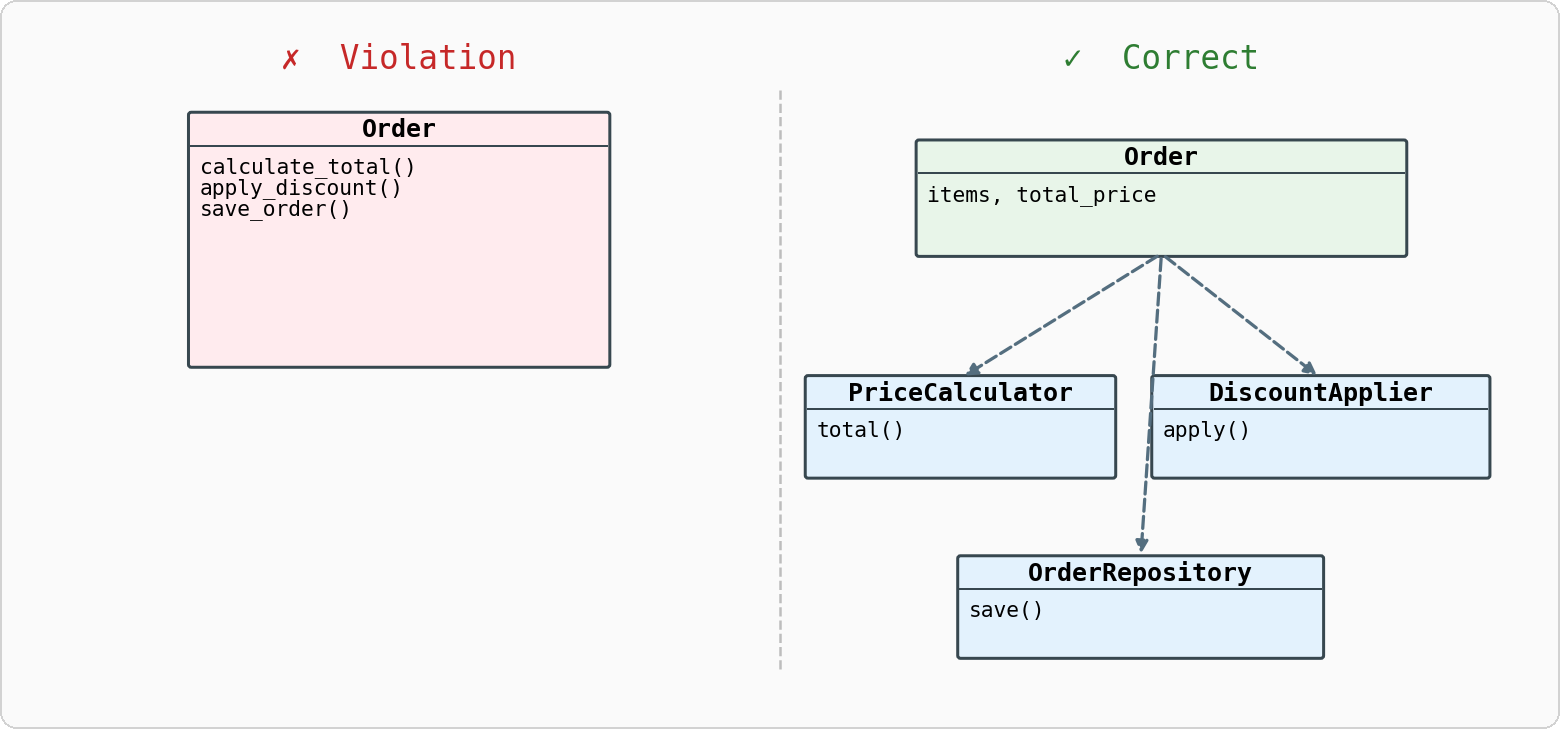
Violation
In violation.py the Order class handles three unrelated responsibilities:
- Price calculation — computing the order total
- Discount logic — applying business discount rules
- Persistence — saving the order to a database
class Order:
    def __init__(self, items: list[Item]) -> None:
        self.items = items
        self.total_price = self.calculate_total()
        self.total_price = self.apply_discount(self.total_price)
        self.save()
Any change to discount rules, pricing formulas, or storage backends forces modification of this single class.
Correct
In correct.py each responsibility is extracted into its own class:
| Class | Responsibility |
|---|---|
Order | Holds order data |
PriceCalculator | Computes the total price |
DiscountApplier | Applies discount rules |
OrderRepository | Handles persistence |
@dataclass
class Order:
    items: list[Item] = field(default_factory=list)
    total_price: float = 0.0

    def finalize(self) -> None:
        self.total_price = PriceCalculator.total(self.items)
        self.total_price = DiscountApplier.apply(self.total_price)
        OrderRepository.save(self)
Now each class has exactly one reason to change, and they can be tested, extended, or replaced independently.