Language: English O’zbek
Dependency Inversion Principle (DIP)
High-level modules should not depend on low-level modules. Both should depend on abstractions.
Instead of hard-wiring concrete classes, use dependency injection to pass abstractions. This decouples components and makes the system easier to test and extend.
Diagram
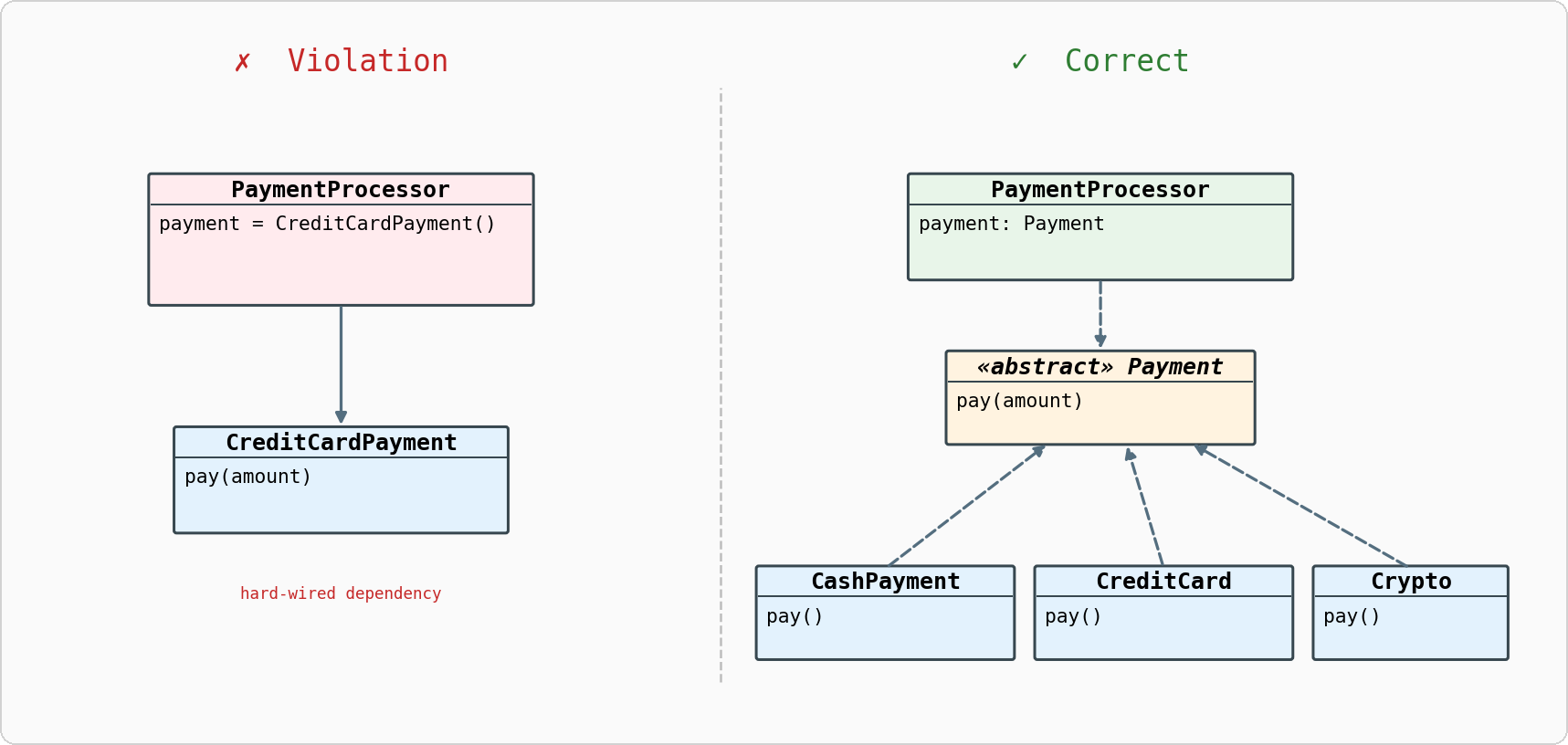
Violation
In violation.py PaymentProcessor directly creates a CreditCardPayment inside its constructor:
class PaymentProcessor:
    def __init__(self) -> None:
        self.payment = CreditCardPayment()  # hard-wired dependency

    def process(self, amount: float) -> None:
        self.payment.pay(amount)
Switching to cash or cryptocurrency requires modifying the processor itself.
Correct
In correct.py both the processor and payment methods depend on a Payment abstraction:
class Payment(ABC):
    @abstractmethod
    def pay(self, amount: float) -> None: ...

class PaymentProcessor:
    def __init__(self, payment: Payment) -> None:
        self.payment = payment

    def process(self, amount: float) -> None:
        self.payment.pay(amount)
New payment methods are added by implementing Payment — the processor never changes:
for method in (CashPayment(), CreditCardPayment(), CryptoPayment()):
    processor = PaymentProcessor(method)
    processor.process(150.00)